
The Payment Layer for Autonomous Agents
Infrastructure for agents that act, not just answer
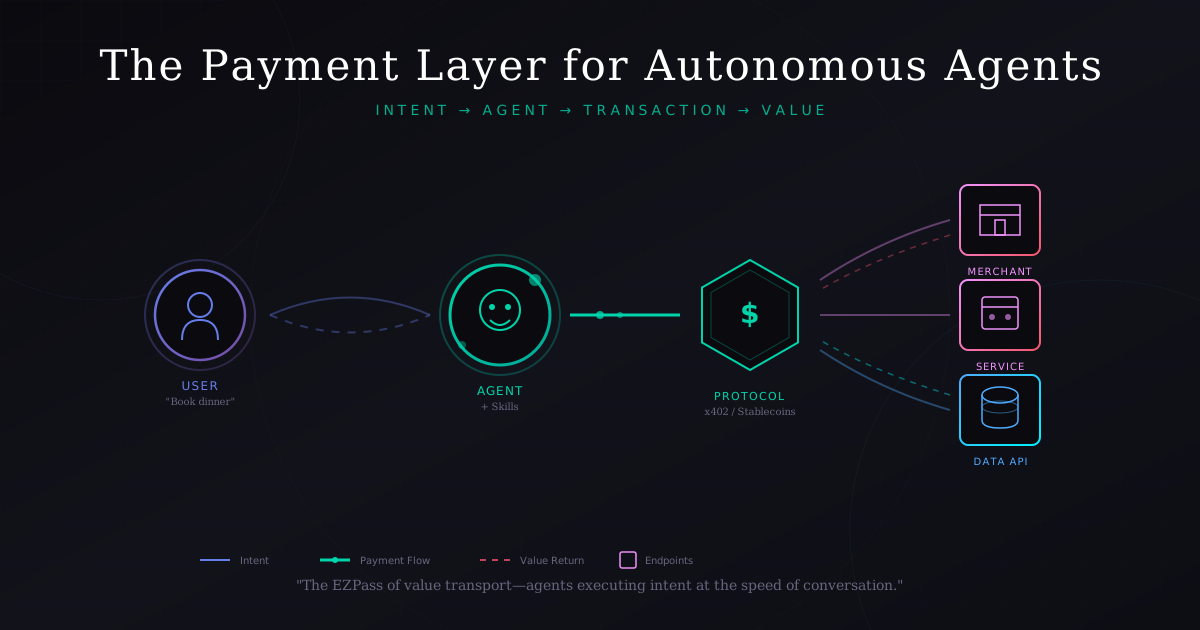
We're watching information consumption transform in real-time. Wikipedia didn't just digitize encyclopedias -it fundamentally changed how knowledge was created and accessed. Now AI agents are doing the same thing to Wikipedia itself. The question isn't whether agents will replace how we interact with information. The question is: what infrastructure enables agents to act, not just answer?
The Subscription Problem
Today's AI landscape forces a strange economics on users. You prepay for capacity you might not use. Credits expire monthly. You need a full ChatGPT subscription to ask one question, just like you need a New York Times subscription to read one article.
This made sense when humans were the customers -bundled pricing reduces transaction friction. But when agents are the users, the model breaks down.
Companies like Anthropic lose margin to credit card processing fees. Users leak value to unused credits. And most critically: agents can't actually do anything that requires payment without human intervention.
The Real Bottleneck Isn't Data -It's Transactions
Current AI agents are remarkable information synthesizers but economically impotent. I can ask Claude to book a restaurant reservation, order lunch, or buy concert tickets. It can tell me how, but it can't execute. Every transaction requires me to click through to OpenTable, DoorDash, or Ticketmaster.
This isn't a design choice -it's an infrastructure limitation.
Traditional payment rails require: - Identity verification tied to humans - Bank accounts or credit cards - Legal liability and chargeback systems - Human approval for every transaction
These systems were built for people, not autonomous software.
The Race to Solve It
The payments industry sees what's coming. In October 2025, Visa launched its Trusted Agent Protocol -a framework for authenticating AI agents making purchases on behalf of users. Mastercard followed with Agent Pay. Google released AP2, backed by PayPal, American Express, and Alibaba. Even Coinbase entered with x402, an open standard for internet-native payments.
These aren't experiments. Boston Consulting Group projects the agentic commerce market will grow at 45% annually through 2030. Visa has already completed hundreds of secure agent-initiated transactions with partners across its ecosystem. The infrastructure buildout is happening now.
The question isn't whether agents will transact autonomously. It's which rails they'll use -and what that choice enables.
The Agent Payment Protocol
Imagine a different architecture. You load $100 in stablecoins into your agent's wallet with spending permissions: up to $25 per meal, $50 for reservations, $200 for entertainment. Your agent now operates as an autonomous economic actor.
"Order me lunch from that Thai place" → Your agent pays the restaurant's wallet directly. The restaurant's system confirms the payment and order simultaneously. Food arrives.
"Book a table for two at 7pm" → Agent pays a deposit to the restaurant's smart contract. Gets a confirmation token. The restaurant knows payment is guaranteed.
"Buy those concert tickets when they drop" → Agent monitors availability, executes purchase atomically when tickets appear. No human could move fast enough.
This isn't theoretical. The technology exists. What's missing is the protocol layer -standards like x402 that make agent-to-business transactions as simple as API calls.
Two Paths Forward
The incumbent approach keeps agents on existing card rails. Visa's Trusted Agent Protocol uses cryptographic signatures to verify that an AI agent is authorized to spend on your behalf, with your tokenized card credentials doing the actual payment. It's elegant: merchants don't need new infrastructure, consumers don't need new accounts, and the fraud systems already exist.
The crypto-native approach is more radical. Agents hold actual funds in wallets. Stablecoin transfers settle in seconds at fractions of a penny. Smart contracts encode spending rules directly. No card networks take a cut. No chargebacks -transactions are atomic and final.
Each has tradeoffs. Card rails offer familiarity and regulatory clarity but preserve the 2-3% interchange fees and require the existing identity infrastructure. Crypto rails enable true micropayments and permissionless participation but demand new user behaviors and lack the consumer protections people expect.
The most likely outcome? Both coexist. Card-based agent payments for mainstream commerce. Crypto rails for the long tail -the niche data queries, the micropayment-dependent services, the agent-to-agent transactions where traditional rails are too heavy.
The Marketplace Emerges
Transactions are just the beginning. As agents become economically autonomous, they need access to specialized data and services that don't exist yet.
Think of the LLM as a liquidity pool, like Uniswap for information and services. When Claude needs specialized data -real-time local information, niche expertise, proprietary datasets -it hits a marketplace where:
- Data providers set prices per query
- Quality builds on-chain reputation
- Agents route to the best price/quality ratio
- Value flows directly to sources
- Settlement happens in microseconds
A restaurant owner installs an SDK, links to a payment processor, and suddenly their real-time reservation availability, menu updates, and special offers become agent-accessible. They earn fractional payments every time an agent queries their data or books a table.
This is the "Uber for knowledge work" -a gig economy where anyone with specialized information or services can participate without business development deals or technical overhead.
Why Crypto Rails Matter for the Long Tail
Here's where blockchain becomes genuinely necessary, not just ideologically preferred.
Traditional API infrastructure is heavy. Integration requires authentication systems, rate limiting, versioning, monitoring. Credit card minimums make true micropayments impractical -you can't economically charge $0.003 for a single query when interchange fees start at $0.21 plus percentage.
For mainstream commerce -booking hotels, ordering food, buying tickets -card rails work fine. The transaction sizes justify the fees.
But for the long tail of agent needs, the economics break: - A weather API query worth $0.001 - A real-time parking availability check worth $0.005 - A niche dataset lookup worth $0.02 - An agent-to-agent coordination payment worth $0.0001
Layer 2 networks like Base and Arbitrum now process stablecoin transfers for $0.01-0.10. Solana and Celo go lower still -fractions of a penny. At these costs, true pay-per-query becomes viable.
Blockchain provides:
Permissionless participation: Any data provider can join without negotiating contracts with every AI company
Granular settlement: Stablecoin transfers enable true pay-per-query pricing at fractions of a penny
Programmable access: Tokens become permission systems. Smart contracts encode usage rights.
Composability: Agents chain multiple data sources and services in a single transaction flow
Economic autonomy: Agents hold and spend funds without human intermediaries
The UX abstractions already exist. Spending permissions let users set budgets. Multi-party computation (like Privy's key shards) eliminates private key management. Circle's Paymaster lets users pay gas fees in USDC rather than holding ETH. Users don't need to know they're "using blockchain" any more than they need to know they're using TCP/IP.
The Skills Layer: Teaching Agents to Transact
Infrastructure matters, but agents also need to know how to use it. This is where the emerging "skills" paradigm becomes critical.
Platforms like Claude now support custom skills -structured instructions that teach agents how to interact with specific tools, APIs, and protocols. A skill is essentially a portable capability: install it, and your agent gains new powers.
Imagine a payment skill that tells an agent: - How to check wallet balances - How to construct and sign transactions - What spending limits to respect - How to verify merchant authenticity - When to request human approval
The skill doesn't just enable transactions -it encodes the judgment around them. Which merchants are trusted. What price thresholds trigger confirmation. How to handle failed payments. The agent imports directions for interacting with payment protocols the same way it might import directions for querying a database or generating a specific document format.
This composability is powerful. A restaurant booking skill could combine: - A payments skill (how to send stablecoins) - A reservation protocol skill (how to interact with booking systems) - A preferences skill (your dietary restrictions, favorite cuisines, budget ranges)
The agent chains these capabilities together. You say "book dinner for Saturday." The agent checks your calendar, finds availability at restaurants matching your preferences, reserves a table, pays the deposit, and confirms -all by composing skills you've already authorized.
For developers, this means payment integration becomes a skill to import rather than infrastructure to build. For users, it means agents that genuinely act on your behalf, with capabilities that grow as new skills emerge. The protocol layer handles value transfer. The skills layer handles intent.
The Hard Problems Remain
This vision has real obstacles that won't disappear with better technology.
The onboarding problem: Crypto payments require users to hold crypto. Despite years of effort, stablecoin adoption remains a fraction of card usage. The "install SDK, start earning" promise for data providers assumes they want to manage wallets and deal with on/off-ramps.
The cold start problem: Marketplaces need both supply and demand. Data providers won't integrate until there's meaningful query volume. Agents won't route to the marketplace until there's valuable data. Someone has to subsidize the early ecosystem.
The quality problem: Traditional API partnerships include SLAs, support contracts, liability clauses. A permissionless marketplace where anyone can list data sources needs robust reputation systems and quality verification. On-chain history helps, but it's not a complete solution.
The regulatory problem: Financial transactions, personal data, regulated services -these require accountable parties and audit trails. Zero-knowledge proofs and KYC/KYB at provider registration can help, but regulators may not accept "the blockchain handles compliance" as sufficient.
These aren't fatal objections. They're engineering and go-to-market challenges. But they explain why this future isn't arriving tomorrow, despite the technology being largely ready.
From Vision to Reality
This isn't data analysis of current bottlenecks. It's infrastructure for a future that's already emerging.
The AI agents market is projected to grow from $7.6 billion in 2025 to over $180 billion by 2033. Personalized agents are multiplying. The question isn't whether agents will need to transact -it's whether we'll build the payment rails to let them.
Payment infrastructure has evolved through progressive simplification: bank wires and merchant accounts gave way to PayPal, which gave way to Stripe's developer-first API. Each layer abstracted away complexity while expanding access. The same pattern is emerging for agent transactions -what used to require complex integrations could become as simple as installing an SDK.
The complementary layer to today's subscription LLMs isn't another chat interface. It's the economic infrastructure that turns agents from sophisticated answering machines into autonomous actors that can query specialized data, book services, make purchases, and settle payments -all while you're asking the question.
Wikipedia proved people would contribute knowledge freely. The next evolution proves they'll contribute it economically, earning micropayments as their expertise gets queried by millions of agents.
The encyclopedia became a website. The website became a conversation. The conversation is becoming a transaction. The metadata will carry payloads of transaction information, like a car passing through a toll on the highway. The EZPass of value transport -built not for humans clicking through checkout flows, but for agents executing intent at the speed of conversation.